
WESTINGHOUSE AIRBRAKE & UNION SWITCH & SIGNAL
Pittsburgh remains a major crossroads of freight shipped by rail. Recent years have seen a decline in coal shipments with an offsetting increase in gas and oil related products. Historically, it was a key site for the manufacturing of essential rail safety systems equipment. George Westinghouse successfully demonstrated his airbrake in 1869 in Pittsburgh and built them in the Strip District before moving the Airbrake plant to Wilmerding in the Turtle Creek Valley. There he constructed his chateau-like headquarters that workers called the “Castle”.
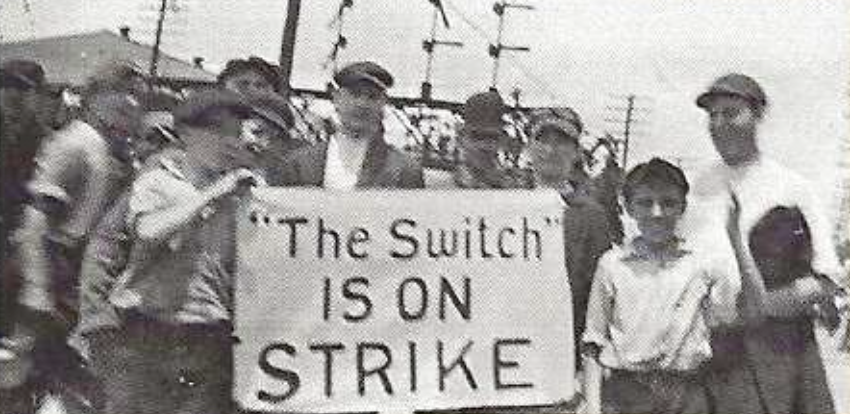
Better braking induced faster speeds that needed systematic electronic controls for safe operation. In 1881, Westinghouse organized the Union Switch & Signal in a plant off Penn Ave. on Garrison Alley in downtown Pittsburgh. In 1886, the Switch was moved to a 45-acre site in Swissvale, now the Edgewood Town Center. At the downtown site, important experiments with alternating current based on the work of the Serbian genius Nikola Tesla were conducted. In 1894, Westinghouse began construction of the massive Electric, Machine and Meter complex in East Pittsburgh. In the great post World War II labor struggle over the issue of Communism in the union movement, the United Electrical Workers (UE) was split. The Electric plant joined the CI O’s International Union of Electrical Workers (IUE), while the Airbrake and the Switch remained in the UE. In 1981-82 a six month strike set in motion a series of moves that closed the Switch and greatly reduced the Airbrake now known as WABCO.
Site of the Union Switch & Signal – now Edgewood Towne Centre
 Pittsburgh Labor History Trail