
PHIL MURRAY TOWER & GRAVE
Pittsburgh’s Phil Murray was the dominant labor leader in America during the 1940s and early 1950s. A longtime union leader in the United Mineworkers, he was a close collaborator with its president John L. Lewis through the 1920s and 30s. While Lewis was the autocratic and eloquent commander at ease with the rich and powerful, Murray was uncomfortable in the limelight or in high society. A devout Catholic, he socialized with workers and was deeply influenced by the church’s social teachings. Murray did the detail work in negotiations and organization. The two men had a bitter falling out over relations with President Roosevelt and attitude toward war preparations. Murray was named the head of the Steelworkers Organizing Committee (SWOC) by Lewis and succeeded Lewis as president of the Congress of Industrial Organizations (CIO). In 1942, he became the first president of the United Steelworkers.
Murray ardently supported FDR and the war effort. Following the defeat of the Axis powers, he reluctantly took on a purge of Communist Party union leaders in the CIO after they broke ranks with the Democratic Party in the 1948 election. Father Charles Owen Rice, Pittsburgh’s labor priest, was a close confidant and ally. Murray is buried near St. Anne Church in Castle Shannon where Rice was pastor. The United Steelworkers built a bell tower there in his honor (41a). On Labor Day, 2007, the 10th Street Bridge (41b) connecting downtown with the former steel-making district of South Side was named for Philip Murray.

A steel bridge connecting the South Side and downtown is named in honor of the labor leader the Philip Murray Bridge, l 0th Street, South Side
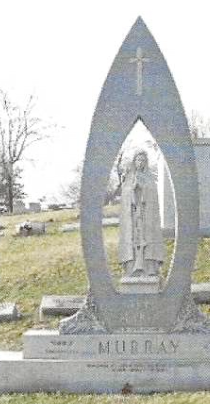
Murray is buried at St. Anne Church in Castle Shannon where Rice was pastor. The United Steelworkers dedicated in 1962 a bell tower at St. Anne’s in Murray’s honor, 400 Hoodridge Dr., Castle Shannon
 Pittsburgh Labor History Trail