
NLRB v. J&L Steel (1937)
The J&L Decision of the US Supreme Court was a watershed of 20th century American labor relations. The conservative court had struck down many initiatives of Franklin D. Roosevelt’s New Deal. In 1935 when the court declared the National Industrial Recovery Act unconstitutional, Congress passed the National Labor Relations or Wagner Act. Industrial turmoil interfering with interstate commerce forced Congress to address the causes of industrial unrest. The Supreme Court ruled “that union was essential to give laborers opportunity to deal on an equality with their employer” and that an “employer may not … intimidate or coerce its employees with respect to their self-organization or representation.”
J&L’s Aliquippa was a very rough town for union organizers. Ethnic groups were segregated into 13 housing plans to maintain divisions. When J&L fired a succession of union activists, the National Labor Relations Board’s charges of unfair labor practices were challenged all the way to the nation’s highest tribunal. President Roosevelt took the extraordinary step of threatening to “pack the court” by adding six new judges. This threat resulted in one Justice changing his vote and the Wagner Act was upheld 5-4. This was called the “switch in time that saved nine.” When bargaining failed, workers struck. It was only the dramatic intervention of Pennsylvania Governor, George Earle, at the plant gate that avoided violence and achieved a union contract. Aliquippa workers rejoiced carrying signs: “The workers of America now free men.”
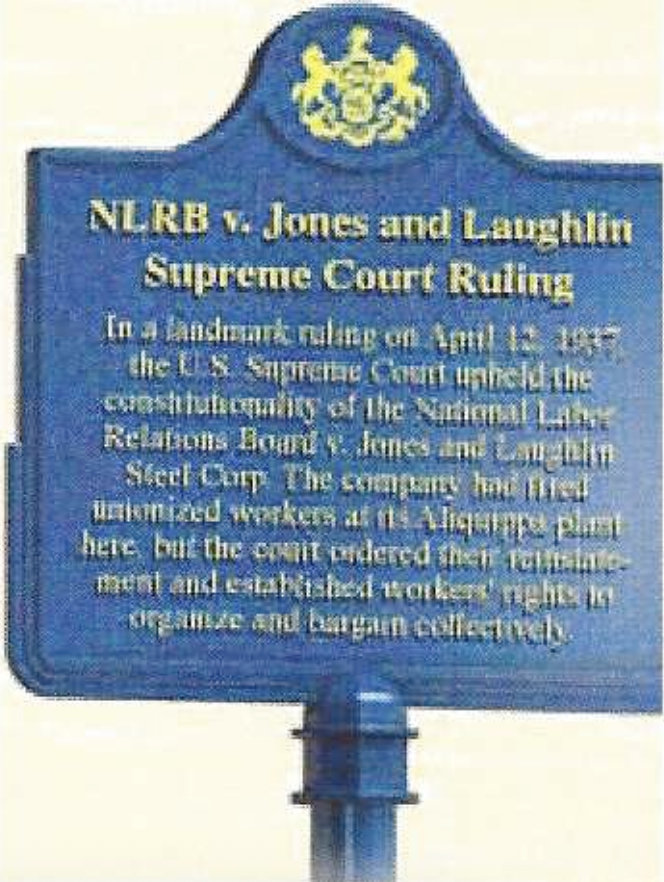
Marker at l l 2 Station Street (Franklin Ave. and Route 51), Aliquippa
 Pittsburgh Labor History Trail