
MCKEES ROCKS STRIKE (1909)
Location: 700 Frederick St, McKees Rocks, PA, 15136
The strike at the Pressed Steel Car Company in McKees Rocks marked a major industrial rebellion by Eastern and Southern European immigrants. Two months of intense labor struggle demonstrated the immigrants’ fighting spirit and organizational ability. Unlike the battle at Homestead where the overwhelmingly Irish leadership of the union spoke fluent English and had effective political control of the town government, in McKees Rocks sixteen different nationalities worked at a large industrial complex of 6,000-8,000 workers. Workers called the factory “the slaughterhouse” or last chance. Steel railcars were produced on a moving assembly line. A complex pooling system determined wages, so weekly pay was unpredictable.
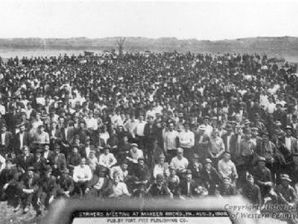
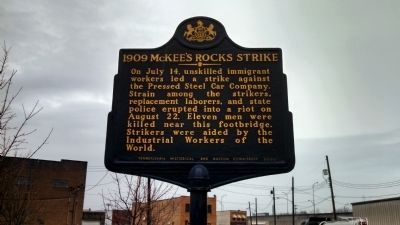
Mckees rocks strike (1909) marker at intersection of Bunson Ave., Nichol Ave and George St., Mckees Rocks
Workers held mass meetings daily on the Indian Mound — the long spur of rock that sheltered the immigrant town from the Ohio River. Violence marked the strike from the beginning as Pearl Berghoff, “king of the strikebreakers”, imported hundreds of replacements. The Industrial Workers of the World (IWW) joined the struggle in early August. The conflict came to a head with an all-out battle in front of the gates on August 22, “Bloody Sunday”, when at least 11 were killed. Three days later, Eugene Debs, Socialist party leader and three-time candidate for the presidency of the United States, spoke from the Indian Mound to 10,000 gathered in solidarity with the strikers. The strike ended with improved conditions, but a split between immigrant workers and skilled second-generation Americans undermined the victory until a USW contract was signed in 1940.
 Pittsburgh Labor History Trail